GTM engineering: why a lead is fit, timing, intent and confidence
Finding leads is easy now. Knowing which lead matters is the hard part. The GTM engineering approach we run for 10+ YC companies: score every account on fit, timing, intent and confidence, then close the loop from signal to revenue.
 Namanyay Goel8 min read
On this page
- Founder-led sales is model training
- A lead is not a row in a database
- Map the market before you attack it
- Timing turns an ICP into a lead
- Outbound, inbound and GTM engineering are one system
- What GTM engineering actually is
- How we built this for a YC F26 company
- Questions founders ask about GTM engineering

We run go-to-market for more than ten YC companies that are scaling pipeline faster than competitors with 20-person sales teams. The pattern behind that is worth writing down, because most founders are optimizing the wrong half of the problem.
Finding leads is becoming easy. Knowing which lead matters is becoming the hardest part. A founder can open a database, pull 10,000 companies, enrich the employees, scrape the websites, inspect job openings, track funding rounds, generate 50 email variants, and launch sequences before lunch. It sounds like progress. Most of the time it is just a faster way to generate noise.
For an early-stage YC company, the objective is not collecting lead lists. The objective is learning which parts of the market convert into paying customers, and then making that learning repeatable. This post expands an article I wrote on X into how that actually works.
Founder-led sales is model training
YC has repeated the same early-stage advice for years: founders need to learn to sell their own product before handing the job to anyone else. Your first 50 sales conversations are data collection. The founder learns which title actually owns the problem, which company can afford to solve it, what event makes the problem urgent, which objections repeat, and which words customers use themselves. That information becomes the GTM system.
The right version of GTM engineering starts manual, becomes systematic, then becomes automated. Skip the manual phase and you automate guesses.
A lead is not a row in a database
The traditional idea of a lead is name, company, email, job title, employee count. That tells you who someone is. It tells you almost nothing about whether you should contact them.
A more useful lead has more dimensions. I think of it as a point in a vector space:
fit × timing × intent × confidence
- Fit determines whether this company can buy.
- Timing determines whether an event makes the problem relevant now.
- Intent determines whether the account is actively evaluating the category.
- Confidence determines how much of that is verified data versus a guess.
For a YC company selling developer infrastructure, "Series A software company with 50 to 200 employees" contains thousands of technically valid accounts. A better definition: Series A or B software company, 50 to 200 employees, engineering team growing, actively hiring platform engineers, using infrastructure your product integrates with, and a senior engineer engaged with your content in the last month. The second definition is more precise, and it also tells you exactly what to say.
This is the scoring that runs before any message goes out. I wrote up the mechanics separately in why filtering the list first lifts reply rates.
Map the market before you attack it
Instead of asking "where can I find 5,000 leads?", ask "what does the complete market look like?" A company that raised three weeks ago, hired a VP in the department you sell to, opened six relevant roles, and installed complementary technology is a smarter motion than an account that only matches a job title.
High-signal accounts justify founder research, LinkedIn multi-touch, and tailored outbound. Lower-signal accounts enter automated email sequences. Once the market exists as one integrated dataset, you score accounts on evidence. Knowing who not to contact protects your time and is how you grow faster.
Timing turns an ICP into a lead
Most outbound systems under-weight timing. Funding rounds age. Executives switch companies. Hiring freezes hit. New budgets open. Products launch. Contracts expire. Someone visits your pricing page. An account that ignored you six months ago can be your highest-probability lead today. The market has to be evaluated continuously, not scraped once.
Outbound, inbound and GTM engineering are one system
The standard B2B model treats outbound, inbound, and engineering as separate silos. Buyers do not operate that way. McKinsey found buyers use an average of ten channels across an evaluation. A buyer discovers you from an X post, searches the brand on Google, asks an AI model for alternatives, reads your docs, hears the founder on a podcast, ignores your first email, and replies to the third.
Content makes outbound warmer. Outbound creates branded searches. Sales calls reveal the language that sharpens content. Website activity updates account priority. It is one loop, and this is the five-step version for anyone starting from scratch.
What GTM engineering actually is
GTM engineering is a hot phrase, but it exists for a reason: AI finally let go-to-market become as precise as engineering. Information has to move without manual re-entry.
- Inbound triggers enrichment.
- Enrichment updates account scoring.
- Score determines routing.
- The owner receives unified account history: page visits, past messages, CRM records.
- Positive replies trigger real-time notifications with context.
- Closed revenue attributes back to the original discovery signal.
- Lost deals feed the targeting model for the next cycle.
The proprietary learning is the real moat. Competitors can copy an outbound template. They cannot copy years of structured market interactions. Every campaign trains the next one. The loop is: run play, capture signal, measure outcome, update model. That closed loop is the engine I described here.
How we built this for a YC F26 company
For what this looks like in production, take Workers.io, a high-growth developer platform in the latest YC batch. When they onboarded, the ask was clear: 8 to 10 qualified demos a week, targeting CTOs, senior SREs and directors of engineering. They did not want another disconnected lead scraper. They wanted a closed-loop outbound machine they could run themselves without pulling engineers off the product.
The workflow we deployed:
- Map the developer TAM. Workers.io gave us a universe of companies running distributed systems and cloud infrastructure. Instead of buying generic contact lists, PumpGTM mapped their full addressable market, filtered accounts by actual stack compatibility, and pulled the exact technical leaders that matched.
- Run it through MCP, not a dashboard. Rather than living inside a web app, the team drives the engine from their AI assistant: "find my sequence about engineering leaders and show me its messages, change the follow-up, and show me the result before activating." That is the MCP setup working the way a founder actually wants.
- Human-calibrated pacing. Outreach starts at a measured pace and scales up, enforcing human sending patterns to protect account health, instead of blasting hundreds of cold invites at once.
- Multichannel in one prospect state. Once accounts were verified, we connected email, LinkedIn and X against a single unified prospect state, so a reply on one channel stops the others.
The system this describes is what PumpGTM runs for founders. If you want the outbound playbook that sits on top of it, it is here.
Questions founders ask about GTM engineering
What is GTM engineering? It is treating go-to-market as an engineering system: information flows automatically from an inbound or intent signal through enrichment, scoring, routing, outreach and revenue attribution, and every result updates the targeting model. The point is precision and a compounding learning loop, not more automation for its own sake.
How should I score a lead? On four dimensions, not just job title: fit (can this company buy), timing (is there an event making it urgent now), intent (are they evaluating the category), and confidence (how much of that is verified). A lead that scores high on all four is worth founder research; a low-timing account belongs in an automated sequence or nowhere.
Why does timing matter so much in outbound? Because the same account changes value over time. Funding, hires, budget cycles, product launches, contract renewals and a pricing-page visit all move an account up or down. An account that ignored you six months ago can be your best lead today, so the market has to be scored continuously.
Do founders still need to do sales manually first? Yes. Your first 50 conversations are how you learn which title owns the problem, what makes it urgent, and the words buyers use. That is the raw material the automated system is built from. Automating before you have it just scales guesses.
Can I run GTM engineering without a full RevOps team? That is the point of running it through an MCP server. A founder can operate the whole loop, find buyers, edit sequences, read replies, from their AI assistant, without a dashboard or engineering time. PumpGTM is the packaged version for founders and small teams.
Original source · 2026-09-18 · Adapted and expanded for PumpGTM
Namanyay Goel · Founder, PumpGTM
Founder of PumpGTM (YC). Writes about founder-led GTM, LinkedIn outbound, and the systems behind it.
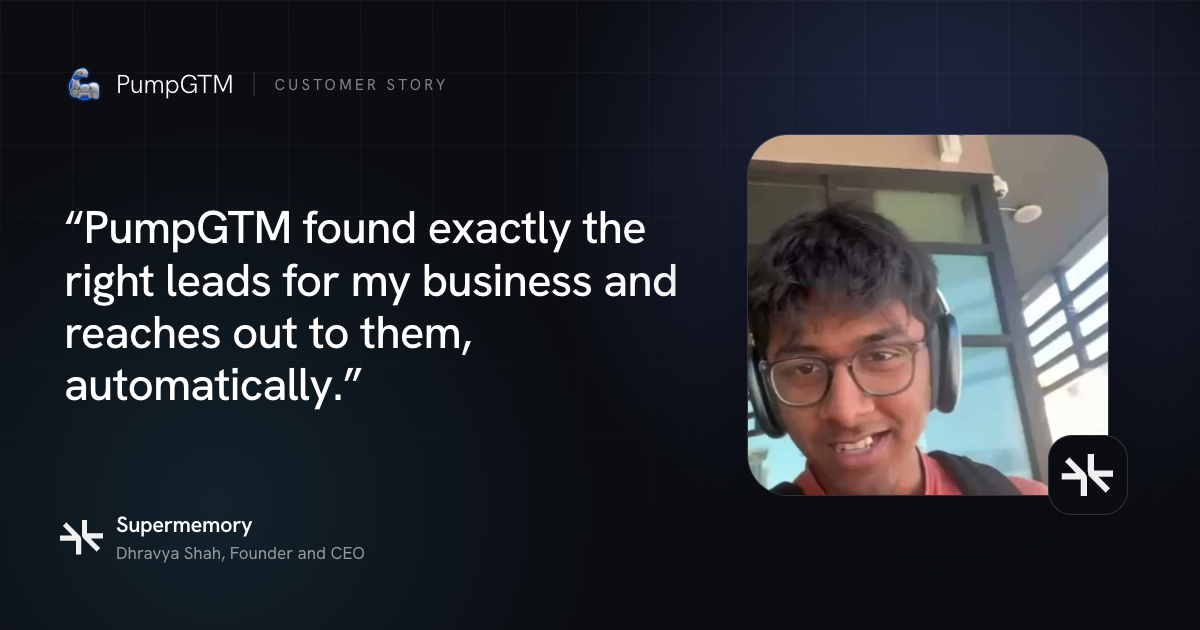
 Supermemory
 Docmost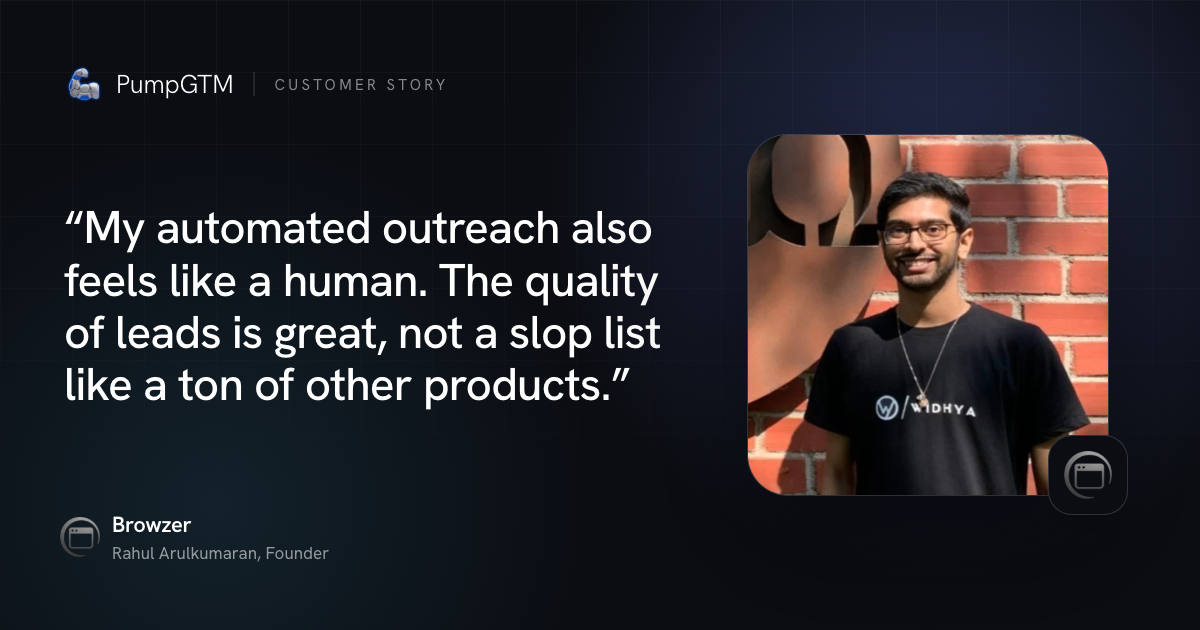
 Browzer