How PumpGTM helped Supermemory find customers
The four-step qualification and outreach process PumpGTM ran for Supermemory, plus a ten-prospect exercise you can do today.
 Namanyay Goel5 min read
On this page
People who think your product is cool and people who actually need to buy it are not always the same people. It is easy to confuse the two when you are looking for customers, because the first group is loud and the second group is busy.
I run PumpGTM (we used to call it GTM Multiplier). We find relevant buyers, run the LinkedIn outreach, and improve the targeting and the messages based on what people reply. We recently helped Supermemory acquire customers this way. This guide expands the answers I gave in an r/B2BSaaS thread into the process itself, so you can run it by hand before you automate any of it.
What "relevant" meant for Supermemory
Supermemory builds memory and context infrastructure for AI applications. "Companies building with AI" describes most of the internet right now, so it is useless as a target.
The qualification questions that actually separated buyers from admirers were:
- Does the app need to remember users across sessions?
- Does losing context make the experience noticeably worse?
- Is the team maintaining this capability themselves today?
- Do they need to solve it now, not in some future quarter?
Before you message anyone, you should be able to explain why that specific person might need your product. If you cannot, you are not prospecting yet. You are collecting names.
Put the reason beside the name
Add one column to your prospect list and make it mandatory:
Relevant because they are building [something], which may require [something else].
For Supermemory a filled-in row looked like: "They are building an assistant for returning users, which may require remembering preferences from earlier conversations."
Then look for evidence that supports the sentence. A demo video. Their documentation. A post where they describe the product. If you cannot finish the sentence without making things up, do more research or move on. This one column is where most of the quality in an outbound list comes from, and it is the part that PumpGTM does automatically for every prospect it proposes.
Ask something the person can actually answer
This is where the research should show up in the message. Ask how they are handling the problem today, then let the answer decide what you send next.
If they have already solved it, find out whether the solution is working before you assume they want another one. A team that built its own memory layer six months ago and hates maintaining it is a great conversation. A team that is happy with what it has is a polite no, and knowing that early saves everyone time.
With PumpGTM you approve the prospect list and the message sequence before anything goes out. Do the same thing by hand: read the message next to each prospect's name and ask whether it makes sense for that person. If the same message works for everyone on the list, it is probably not specific enough for anyone.
Track what happens after the reply
Keep these stages separate and count each one:
Relevant prospects, then replies, then qualified conversations, then evaluations, then customers.
Each gap points at a different fix:
- Replies but no real need: revisit who you are targeting.
- Real need but no evaluation: ask about timing, switching effort, and what is stopping them.
- Evaluations but no customers: find out what happened during usage.
Without these stages you keep rewriting the opener when the problem is three steps further down the funnel. If the opener really is the problem, run it through the anti-slop checklist before changing anything else.
Try it with ten prospects
Take ten prospects. For each one write down what they are building, why they might need you, what evidence you have, and one question you still need answered. Send only to the ones where all four lines are filled in honestly.
That exercise is a small version of what we ran for Supermemory. The difference at scale is that PumpGTM does the research and the drafting, watches the replies, and shifts the targeting toward the segments that turn into conversations.
Transcript
PumpGTM can help me to find exactly the right leads for my business and send them a message. Hopefully it drives a lot of sales and saves a lot of time. Let's go. It will.
Questions founders asked in the thread
Should budget or authority be a qualification question? Yes, eventually. Early on I would rather find the person who feels the problem, even if they cannot sign the contract, because they will tell you who can and what that person cares about.
How many prospects do you need before the stages tell you anything? Fewer than you think. Ten well-researched prospects with honest notes teach you more than five hundred scraped rows.
Does this work outside AI infrastructure? The four steps are the same for any B2B product. What changes is the "relevant because" sentence and where the evidence lives. Two good places to look for evidence: competitor comment sections and engagement on posts about the problem.
If you want the same process run on your own product, start at pumpgtm.com. You enter your website, PumpGTM proposes the first prospects and the reason for each one, and you approve before anything is sent.
Original source · 2026-09-08 · Adapted and expanded for PumpGTM
Namanyay Goel · Founder, PumpGTM
Founder of PumpGTM (YC). Writes about founder-led GTM, LinkedIn outbound, and the systems behind it.
 Hank
Hank
 Workers.io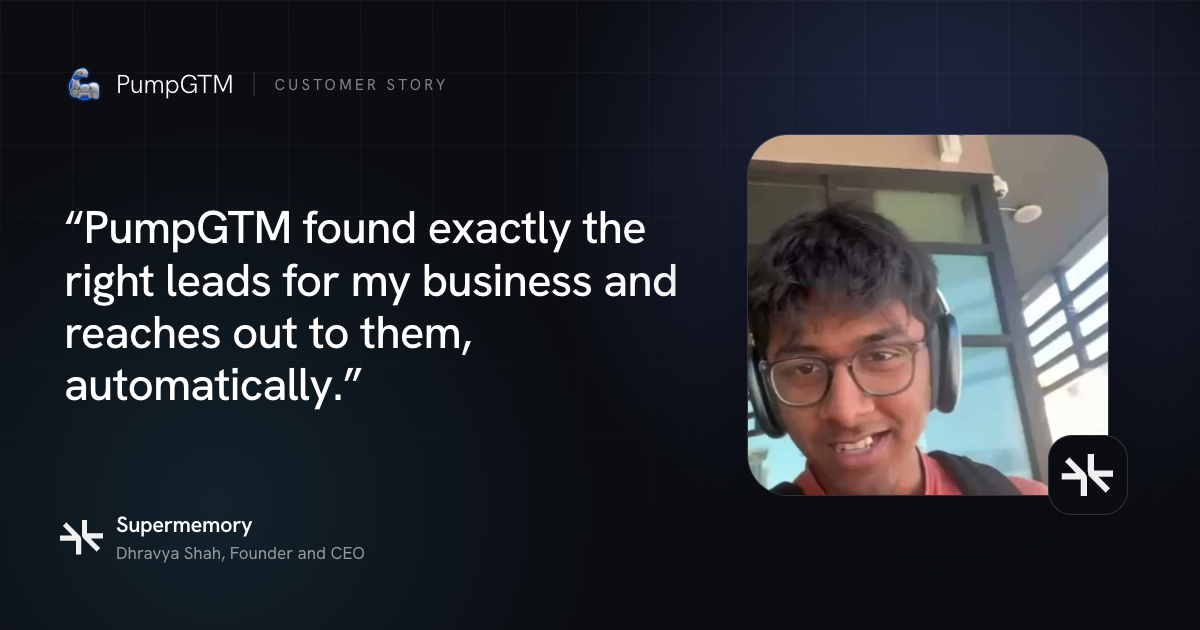
 Supermemory