GTM is simpler than you think: the 5-step go-to-market framework
Go-to-market is not cold email, content, ads or sales. It is five questions answered in order: person, place, approach, action, feedback. Here is the framework, with a non-tech example.
 Namanyay Goel4 min read
On this page
- 1. Person: who are you trying to reach?
- 2. Place: where can you reliably find their attention?
- 3. Approach: channel versus tactic
- 4. Action: what should the person do next?
- 5. Feedback: what happened after you tried?
- The framework outside tech: a neighborhood restaurant
- The takeaway
- Questions founders ask about go-to-market
A lot of people overcomplicate this. Go-to-market is much simpler than you think.
Most founders hear "GTM" and assume it requires a complex tool stack and a bag of growth hacks. It does not.
- Cold email is not GTM.
- Content is not GTM.
- Ads are not GTM.
- Sales is not GTM.
They can all be parts of it, but none of them define it. At the most basic level, go-to-market is a loop of five steps:
person → place → approach → action → feedback
This post expands a thread I wrote on X. Here is what each step actually means.
1. Person: who are you trying to reach?
Not a vague market category like "B2B companies". An actual type of person dealing with an immediate problem today. If you cannot describe the person and the problem in one sentence, nothing downstream will work.
2. Place: where can you reliably find their attention?
LinkedIn, X, corporate email, Google search, YouTube, or an in-person event. Pick the place where your person already spends attention, not the place that is easiest for you.
3. Approach: channel versus tactic
This is where most people get confused.
LinkedIn is a channel. Founder content is a tactic. Sales Navigator searches are a tactic. Direct outbound messages are a tactic. Commenting on industry discussions is a tactic.
Same place, completely different ways of using it. When someone says "LinkedIn does not work for us", they usually mean one tactic did not work.
4. Action: what should the person do next?
Walk through the door, start a trial, book a 15-minute call, or reply with their current workflow. Your call to action needs to be crystal clear, and it should be one thing.
5. Feedback: what happened after you tried?
This is the step that turns random promotion into actual go-to-market. Did the right people respond? What specifically caught their attention? Where did they drop off? What should change on the next attempt?
Skip this step and you are not running GTM, you are running experiments you never read the results of.
The framework outside tech: a neighborhood restaurant
- Person: people living or working within four blocks.
- Place: Google Maps and street foot traffic.
- Approach: sidewalk chalkboard menu, local food reviews, weekday lunch specials.
- Action: walking in and ordering.
- Feedback: did the chalkboard bring more office workers than the lunch discount?
The takeaway
You do not need a massive growth stack to start. You need answers to five basic questions:
- Who should care?
- Where can I reach them?
- What will make them pay attention?
- What do I want them to do?
- What did I learn after trying?
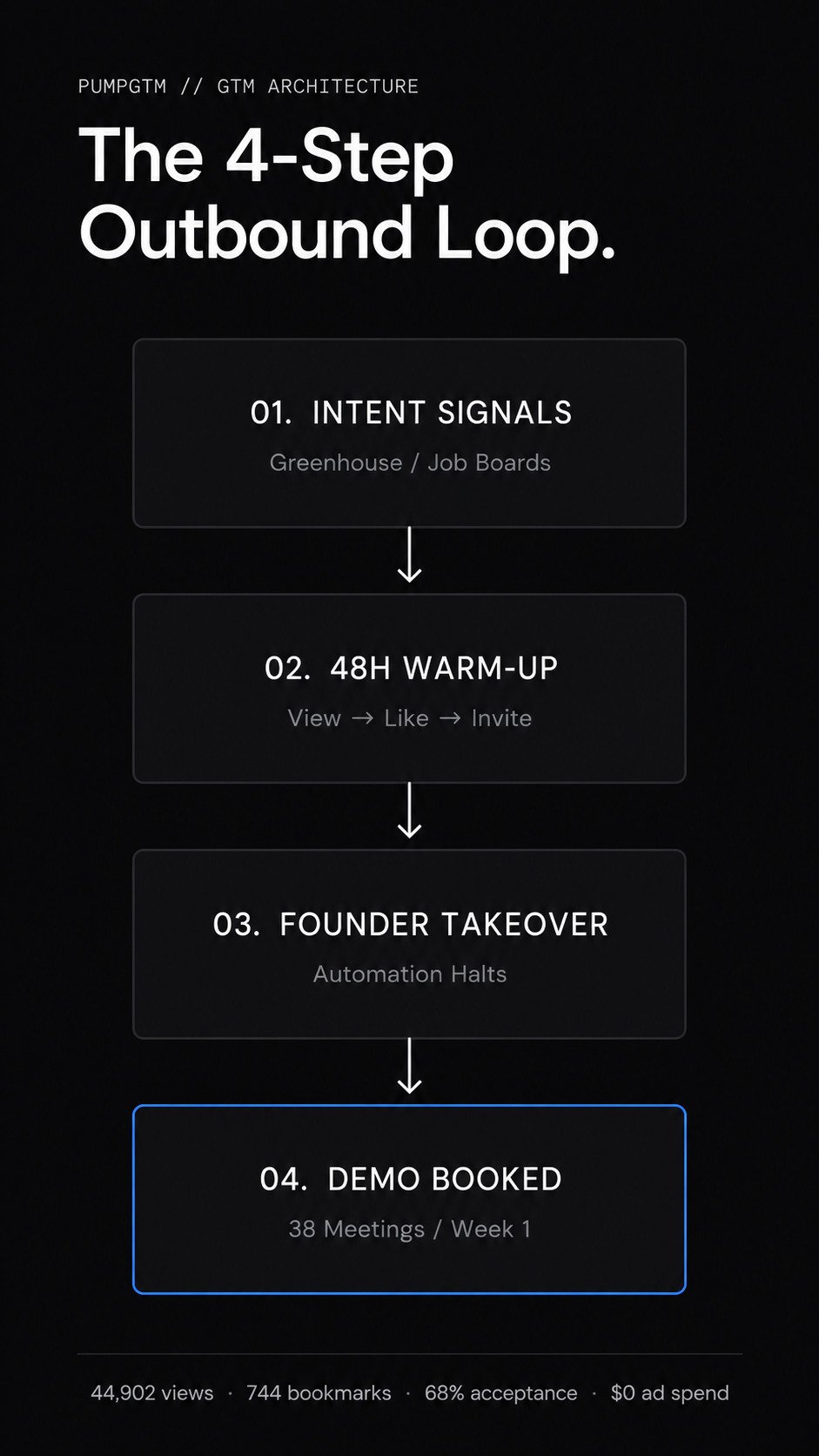
Do it repeatedly and you start building a real go-to-market motion. The next step is turning that motion into an engineering system instead of a collection of random experiments, which is what PumpGTM does for the LinkedIn channel: it finds the person from live intent signals, runs the approach from your own account, and feeds every reply back into targeting. I wrote up how that closed loop works separately.
Questions founders ask about go-to-market
What does GTM actually mean? Go-to-market is the repeatable loop of choosing a specific person, finding where their attention is, picking a tactic on that channel, asking for one clear action, and learning from the result. Tools and channels are inputs to it, not the definition.
Is cold email a GTM strategy? No. Cold email is one tactic on the email channel. It can be part of a GTM motion once you know the person, the action you want and how you will read the feedback.
What is the difference between a channel and a tactic? A channel is the place, such as LinkedIn or email. A tactic is how you use that place, such as founder content, direct messages or commenting. One channel supports many tactics, and they perform very differently.
How do I know if my GTM is working? Run the feedback step honestly. The right people responding, clear reasons they paid attention, and a shorter path to the action each round are the signs. Volume of activity is not.
Original source · 2026-09-11 · Adapted and expanded for PumpGTM
Namanyay Goel · Founder, PumpGTM
Founder of PumpGTM (YC). Writes about founder-led GTM, LinkedIn outbound, and the systems behind it.
 Supermemory
 Docmost
 Browzer