How AI runs go-to-market: the closed-loop GTM engine behind 10+ YC companies
AI moved from assistant beside the workflow to operator inside the loop. The architecture: company knowledge, live GTM records, defined workflows, tools, human approval, and one rule about structured access first.
 Namanyay Goel4 min read
On this page
I spent two days explaining what GTM actually is. This post is about how it is being powered up by recent AI improvements, and the architecture we run at PumpGTM for more than ten YC companies in San Francisco.
For the last two years, models mostly sat beside our workflows. You gave one a spreadsheet, it drafted an email. Recently the model became capable enough to move from an assistant into an operator inside the loop. That changes what a GTM system can look like.
The architecture
Every deployment is the same six ingredients:
company knowledge + live GTM records + defined workflows + best models + tools + human approval
- Company knowledge is what the customer sells, to whom, and what has worked before. It is the thing the model reads before it does anything.
- Live GTM records are the actual leads, conversations and outcomes, kept current. Not a stale export.
- Defined workflows are the steps a human would take, written down so the operator follows them instead of improvising.
- Best models do the reading, judging and drafting.
- Tools are how the model touches the outside world.
- Human approval sits in front of anything irreversible.
One critical rule: structured access first, computer use when necessary
The priority order for tools is fixed:
API > MCP > script > direct browser interaction
If a CRM has a clean API, we use the API. If a workflow can run through an MCP server, we route it through MCP. We only fall back to direct computer use for edge cases where no structured interface exists. That is far more reliable than building an AI that just moves a mouse and hopes the page looks the same tomorrow.
Then we connect the loop
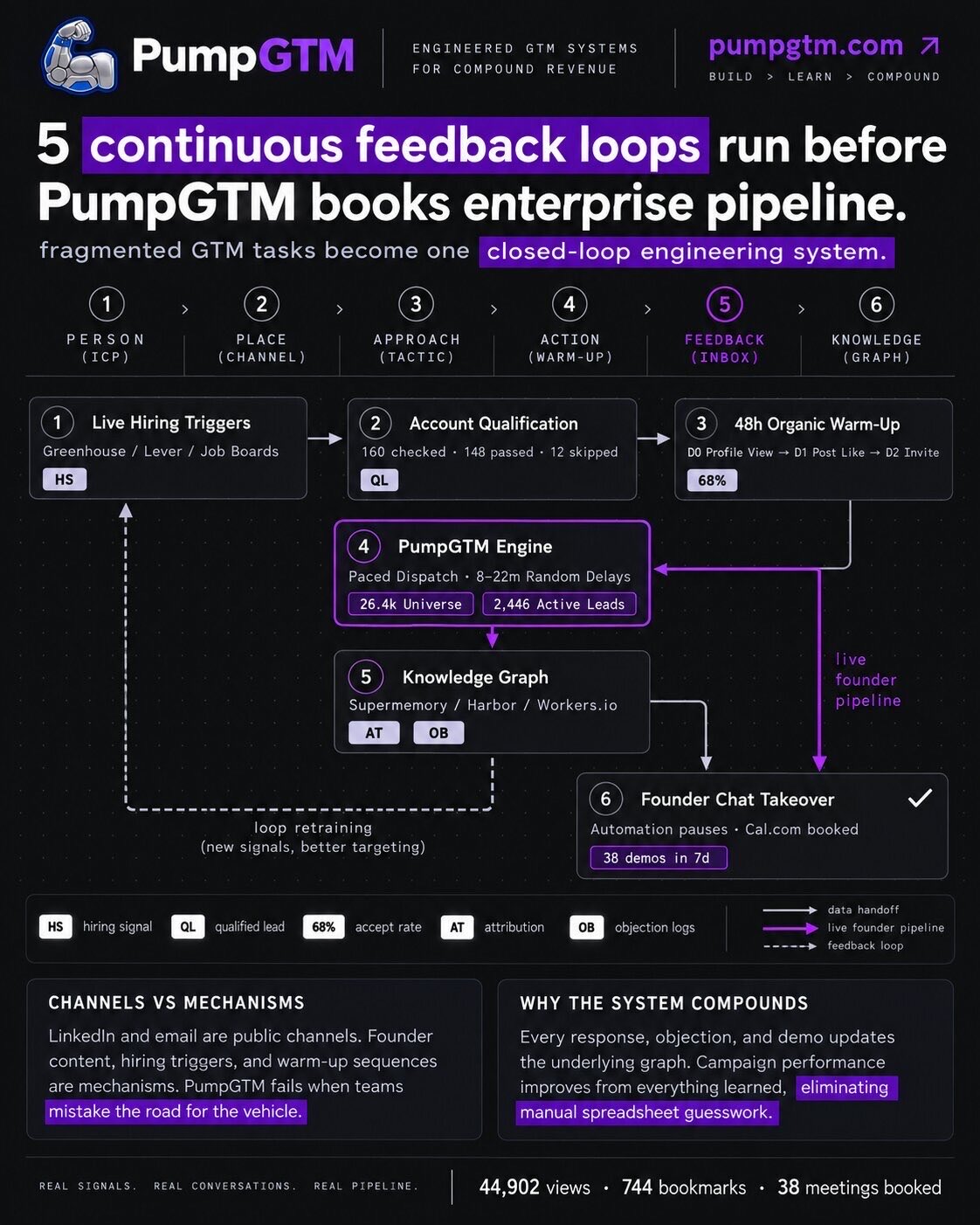
Each stage hands data to the next, and the last stage feeds the first:
- Customer conversation
- Content idea
- Audience intent signal
- Account qualification
- 48 hour warm-up
- Founder meeting booked
A real conversation produces a content idea. The content surfaces people showing intent. Those accounts get qualified, warmed up over 48 hours from the founder's own LinkedIn account, and handed to the founder the moment a qualified buyer replies. Every response, objection and demo updates the underlying knowledge, so the next round targets better. That is the loop retraining arrow in the graphic.
Results across our campaigns, last 7 days
| Metric | Result |
|---|---|
| Views and bookmarks on founder distribution | 44,902 views, 744 bookmarks |
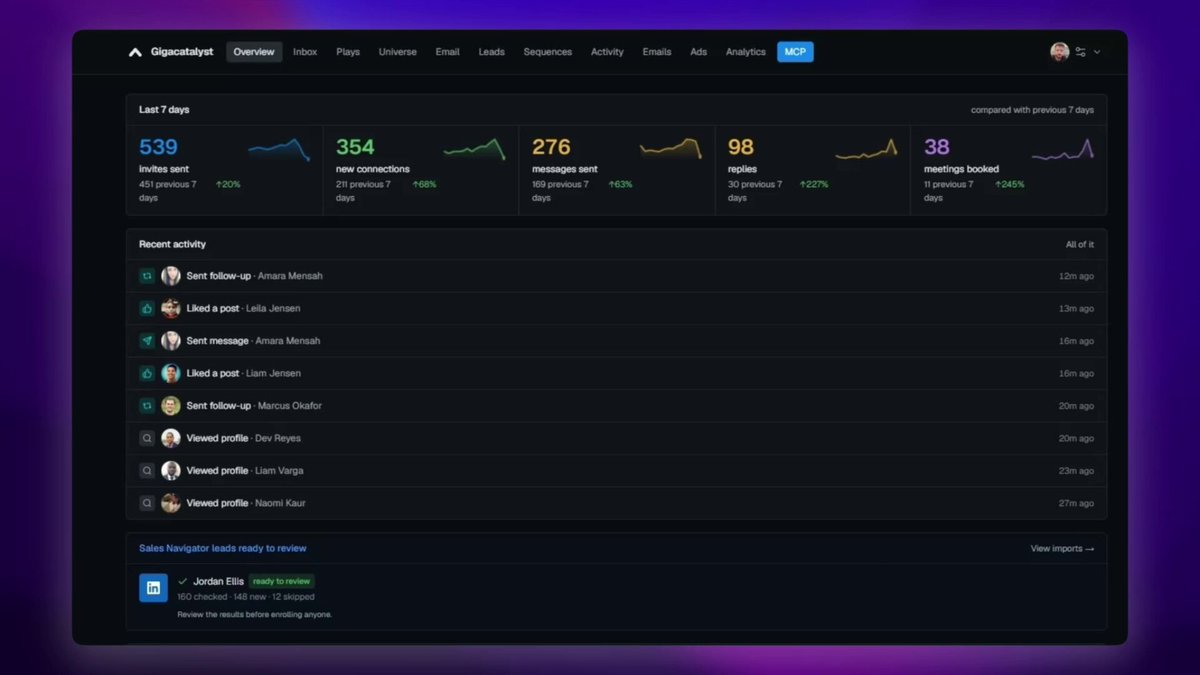
| Invites sent | 546 |
| Accepted connections | 356 (68% acceptance vs about 20% standard) |
| Enterprise demo meetings booked | 38 |
The detailed outbound steps behind those numbers, including the objection branches, are in the 4-step LinkedIn outbound playbook.
This post expands a thread on X. If you want this engine running on your own account, PumpGTM is the packaged version, and it works as an MCP server for Claude and other AI clients.
Questions founders ask about AI-run GTM
Can AI run go-to-market on its own? It can run the loop, but not unsupervised. The model reads company knowledge and live records, follows written workflows, and uses tools, while a human approves anything irreversible and takes over the moment a qualified buyer replies.
Why prefer APIs and MCP over browser automation for AI agents? Structured interfaces return the same shape every time, so the agent's actions stay predictable. A browser changes layout without warning. We use direct computer use only where no API or MCP route exists.
What is a closed-loop GTM system? One where the outcome of every message, reply and meeting feeds back into targeting and content. Fragmented tasks in spreadsheets never learn. A closed loop gets better each week without anyone rebuilding the list.
What is MCP in a GTM context? Model Context Protocol lets an AI client such as Claude call your GTM tools directly, for example to find buyers, draft messages or read replies from your own LinkedIn account. PumpGTM exposes its engine this way.
Original source · 2026-09-12 · Adapted and expanded for PumpGTM
Namanyay Goel · Founder, PumpGTM
Founder of PumpGTM (YC). Writes about founder-led GTM, LinkedIn outbound, and the systems behind it.
 Docmost
 Browzer
 Workers.io